Spokane: The Lost City of Potential [Travelogue]

Before I leave the United States for such a long stretch, I thought I should speak about the last place I will have lived, and currently reside.  Spokane, Washington.  I’m not ashamed to say that I truly love this city.  Even though I can perfectly understand why a westward bound traveler would rather land themselves in Portland, Oregon over this region, I still love this place.  I’ve had my ups and downs living in this city.  So many things I would like to forget, but just as many things I will always cherish.  And as I depart from its plain of existence, I wish only the best for Spokane and its people.  Let’s begin….

Riverfront Park

Spokane, Washington was once destined for a somewhat divine greatness.  In the mid to late 19th century, it seemed as though this region held everything you could every need to exist in the newly trampled Northwest territory.  As the city’s current motto states, it was “Near Nature, Near Perfect”.  Then, and now, it was a vastly expanding metropolis equipped with a large river that proved both beautiful and profitable.  For anyone looking to move any and everything along this river.  Throw in a later boom in mining around the present day Couer d’Alene and Northern Idaho area that proved (just as it does today) to be a very convenient and by far cheaper to operate within that say, you know, the other place that was known to draw in miners across the globe.  Throw on top of that the inclusion of the Union Pacific railroad driving through, and it appeared as though this place could hold nothing but great things for the future.  By 1900, the population of Spokane was well over a hundred thousand, which was even after The Great Fire that almost wiped the damn place off the map.

But, alas, you don’t hear of Spokane in the same way it may have been expected to have this place be on par with the likes of San Francisco, Chicago, etc.  So what happened?  Well, the story is actually a whole lot better documented and embedded with corruption, greed, and a stand-off between the International Workers of the World and the giants of  the corporate world, than I could ever really get into.  Let’s just say, things have slowed down a bit.

But, to even have reached the current state in is now, Spokane had to develop itself in a world that really didn’t seem to give a damn if it succeeded or not.  In 1974, Spokane hosted the first ever environmentally themed World Expo which left a pretty spectacular sprawl of a park in the downtown area, which I will surely speak of more.  It has also a city that subsequently needed to leave its manufacturing roots behind after an almost obsessive collection of failures and ineptitude that may not be entirely the people’s fault, rather the on slaught of the American dream simply fading into a different direction, leaving The Lilac City in the proverbial dust, so to speak.  The city can now boast itself as a thriving facilitator of several amazing opportunities for collegiate advancement, especially in the medical world.  Population has slowly risen.  110 years after reaching 100,000, the city itself has broken the 200,000 barrier, and the Spokane/Couer d’Alene metropolitan area can show over 600,000 residents, respectively.

Riverfront Park

Yet, where is the hope?  Where does the potential really lie?  How does one truly epitomize or even describe what Spokane really is to the rest of the world?  In my own personal opinion and experience in this city, Spokane can be described by what it actually isn’t.  There are two VERY important things that Spokane is not that need to be addressed.  And what are these two things?  Well, Spokane is NOT:

Seattle or Portland.

When somebody from outside of the Pacific Northwest (or even within its boundaries, at times) thinks of the gloomy, caffeine laced, region of this country, Spokane is not what they envision.  They know grunge music, indie rock, rain, The Goonies, Starbucks, Microsoft, etc.  It’s really a tired story for most of us from this region.  I specifically understand the differences being born in a failed industrial town actually situated within the walls of liberalism and the divine social epitaph of society in which most see the world.  I grew up in a town at the base of Mt. St. Helens that is simply a stone’s throw from Portland, and only a bit further from the technologically enhanced Seattle.  Yet, black and white can not even begin to explain the difference between where I lived what people think when they think of this region.  And if you live here, you know that the Cascade Mountains might as well be the equator that divides heaven and hell, which could be on either side dependant upon how you want to look at it.  If you don’t live somewhat along the coast, you live in a prairie farm town nobody has heard of (at best, you live in Spokane), which millions of people will find hard to believe.

So, why is it important to note that Spokane is definitely NOT one of these cities?  Well, for their own damn good really.  One walk through the downtown area of this city, and you will see what is obviously a collection of medium-sized buildings with the influence of the cities it can never be, but so obviously yearns to be more like.  There are more bars than you could throw a hooker from Sprague Ave. at, and also has certain commodities that you just really wouldn’t expect to see in this region.  Say, an Apple store.  One street is lined with concert venues (including a Knitting Factory, which always surprises out of towers) that rivals in comparison to the scene in Portland.  They’ve also managed to make Spokane a pretty walker friendly city, even when temperatures are known to drop well below freezing in the winter with several buildings being connected by enclosed walking bridges.  Yes, as I have clearly stated, the potential is there.  It would actually become a bit lengthy and wordy of a description if I tried to acknowledge all the positives of this city, as they are indeed plentiful.  But, alas there is still a probable.  Let’s all it, an identity problem shall we.

Spokane, Washington

Novelist Jess Walter epitomized the brilliance of his hometown of Spokane better than I, or anyone else probably, really could have in his harrowing novel, Citizen Vince.  How did he do this?  By explaining to us why Spokane is probably one of the greatest cities for somebody in the witness protection program to hide out at.  Why?  Well, it’s not a large city.  But, it’s no small town neither.  It is a city that you can actually go your whole life without really knowing anybody in, and be just fine.  You don’t have to stand out if you don’t want to.  And the resources to live a meaningful yet unnoticed existence are definitely there.  The problem?  This element of simplicity over extravagance is simply not an American way of thinking, is it really?  Canadian, definitely, but not in this country.  No, we are a capitalist nation.  Our goals are supposed to be ever-expanding and more than likely never reached prior to our demise.  That being said, for many Spokanites, the fact that they will never “accomplish” (for a lack of a better word) what Seattle or Portland has “accomplished”, is something they will never be able to look past.  Which, as we all know, is not a far self-realization at all.  This is not to say that there isn’t anybody around here who appreciates the surroundings they DO have.  They are there.  Likely enough, they are probably the same people who feel as though Spokane has been suffice enough to reach their every single need.  And this is can be a good thing.

Case in point: Every year Spokane’s free weekly newspaper, The Pacific Northwest Inlander (one more fine commodity Spokanites should greatly appreciate if they don’t already) does a “Best of 20_” for everything in the area, especially when it comes to food.  There are indeed some amazing eateries in this area.  Maybe not any sort of special forte, but some really good places.  Places that could easily rival neighborhoods in Seattle or Portland based on quality itself.  But, when this list is revealed, what do you think is there?  For best burgers, fries, Mexican food– Red Robin, Zips, and Azteca respectively.  And while this may simply

Spokane, Washington

be because people really dig these chains because they hold some sort of special quality around here that others don’t (Idaho and Washington DO have amazing potatoes), this is simply something you are not going to see happen in the twin cities Spokane seems to live in the shadows of.  That and throw in the fact that Spokane is consistently on the list as having more fast food restaurants than you could really imagine (don’t believe it, take a drive down 3rd Ave and count them out, and try not to get in a wreck).  Simply stated, a small independent newspaper in Portland would never see this sort of thing.  And what does it matter?  Shouldn’t Spokane truly embrace its differences from these other sacred holy hipster lands?  Shouldn’t the lack of pretentious fortitude be a celebrated thing?  Spokane has the little nooks and coffee shops with guitar strumming, angel headed hipsters lurking about, just like every city on the planet!  Why do we care what the residents of the city choose as their favorite french fries?  Why can’t they be proud of what they do have, and stop worrying about what they don’t, or how the outside world looks at them?  Yes, this is about food, but it’s not as simple as that.

Spokane has its arts community.  It has events that bring joy and love to its residents.  It has good food, plenty of things to do.  It is located on a beautiful river and amongst some pretty exquisite nature.  But, it is not Seattle.  It is not Portland.  Just as a pig can never be a cow, Spokane can never been these cities.  But, don’t some people prefer pork chops over a steak?  And until all Spokane’s residents realize this idealism to be self-evident, I’m afraid Spokane will never have its own identity.

Spokane, Washington

But, with the potential in place, it’s not time to give up hope.  Call me Barack Obama in 2008, but I still have hope for this city.  Even if I am abandoning this metropolis for what will probably be for good, I will still hold hope this fair city, and for the fine folks who see it for what is it, and not for what it can never be.

To be continued…..

Bud Cort [Interview]

Bud Cort is a classically trained artist who has proven himself as a ridiculously talented actor for more than 40 years.  He’s proven himself a genius of the stage and screen.  He’s had roles that have left audiences spell bound.  He’s undoubtedly one of the finest actors of this time, and of a time before many Trainwreck’d readers can even remember.

A quick IMDB search will point you into the direction of so many great pieces of work that Bud Cort has been a part of.  When I was a younger lad, the name Bud Cort was only synonymous with Kevin Smith’s Dogma.  But, as I grew older, and more in tune to the world of film beyond my own personal stigmas and accelerations towards commonalities (I am STILL a huge Kevin Smith fan, mind you), I can now state that I best know  Bud Cort for the same reason most of you will know him for as well.  He is Harold.  As in, Harold and Maude.  A film that so utterly pre-dates itself that it is almost impossible to deny.  And while he has done several wonderful films, television shows, and stage performances since, the hipster love child in many of us will always remember Bud as Harold.  But, we shall learn a bit more.  And thankfully, Mr. Cort was kind enough to sit down with us and chat it up a bit about his illustrious career and what he has been up to lately.  Enjoy!

 You’ve had an amazing career on the screen, and equally so on the stage.  If you were to only choose one, which would you say would hold a more prominent spot in your heart?

Radio. I got to read the entire J.D Salinger novel “Catcher in the Rye” for radio station K.P.F.K. in Los Angeles.  The whole book is written in the first person so it’s really the greatest monologue ever put down for an actor. A close second would be when I played Clov in Samuel Beckett’s “Endgame” at the Cherry Lane Theater in New York and then in Los Angeles at the Mayfair Theater.  Third would be “She Dances Alone”. This film is a jewel. It’s about madness and the artistic process and the great dancer Nijinsky through the eyes of his eccentric daughter Kyra Nijinsky who by looking at you would never believe she could possibly evoke her father through her own dancing. I played the director of this film within a film and Max Von Sydow narrated it reading from Nijinsky’s diaries.  It’s magical.

What was it like living with Groucho Marx for an entire decade?  

It was a Fulbright scholarship in comedy.

Did your mother actually turn down a marriage proposal from Clark Gable?  

(Laughs) No, no. She worked for MGM studios in New York during the war when my father was over in Germany fighting. (His troop was the first in to liberate Dachau, (the concentration camp). They had to clean it up at its worst for the arrival of Eisenhower and his brass. My mother was a part of special services for MGM, which today would be considered the p.r. arm of a studio. She would pick Clark Gable up at Grand Central Station, escort him to the Plaza Hotel, and sit through all of his interviews for his latest film. Afterward if he was hungry or just wanted to be around people she would be his companion for dinner and dancing at the Stork Club. By the end of the week if he was fried she would drive him to a little hotel in the Poconos. Obviously both being married they had separate rooms. But anytime she spoke about him she always got a special faraway look in her eyes. I always fantasized he was my father because of my dimples and frankly I didn’t look that much like my own father. She was also great pals with Harold Lloyd.

You were absolutely incredible in your portrayal of Bill Ubell in The Life Aquatic with Steve Zissou.  And Wes Anderson is a personally hero of mine so I have to ask, how was it working under the direction of Anderson?  I can only imagine a fantastic experience…. 

Wes is a meticulous captain. He is so singular and so prepared that he can’t help but get exactly what he envisions. I’m a method actor so preparation is my middle name. Wes and I did go toe to toe on my character’s wardrobe. I thought my costumes looked like diarrhea, my own research into bond company personnel informed me that they were always a well dressed, smart and together bunch of people, but Wes was adamant on a more dweebified look. When I saw the film I was blown away by how right he was. Wes has his own, very unique genius and he just gets better and finer. I just loved “Moonrise Kingdom”.

You reportedly turned down the role as Billy Bibbit in Milos Forman’s adaptation of One Flew Over The Cuckoo’s Nest out of fear of typecast.  Now almost 40 years later, do you believe you made the right choice?  

Hell no. But when I was offered it a different actor than Jack Nicholson was supposedly doing the film. Later on, after I’d turned it down, I found out Jack was now playing McMurphy. I flew to the phone to called Milos (Forman, the director) and Michael Douglas (the producer). But it was too late. Billy Bibbit had been cast with Brad Dourif who was great.

You played John Doe Jersey, a.ka. God, in Kevin Smith’s “Dogma”.  How do you even begin to prepare to play the role of Earth’s curator and guardian?

I looked in the mirror a lot. (kidding) I am a good Catholic boy, you know.

It would be naive and rightfully inconsiderate to ignore the fact that most of the people reading this interview probably know you best as Harold from the 1971 classic comedy Harold and Maude.  The film was not an initial success, but grew to classic status. Why do you think this is?  Is it a “story ahead of its time” sort of scenario? 

As I was reading the script I immediately knew it was going to be a classic film for the ages. There was no denying it.  The studio was stumped on how to publicize it. The art for newspapers and theater posters was plain black, block lettering on an empty background it was more appropriate for The Ten Commandments! Truthfully, it’s success came from the people. The ground swell of word of mouth dropkicked it over so many goalposts both here and abroad- that Paramount had to re-release it.

In a perfect world, the 1991 film Ted and Venus which you wrote, directed, and starred in would receive its own following as well.  Were  there any personal inspirations behind creating this film, which I have heard was based on true events?  And are we ever going to see an American DVD release?

There is a bootleg DVD that people have tracked down online. I personally would love to have it properly re-released to DVD by the studio. I also would love to have another quick pass in editing. I shot stuff that would be wild for today’s audiences but back in 1991 the studio was, hmmm… shall we say a little reticent? Nevertheless, I got about 99 percent of what I was going for, but for me that missing one percent still drives me nuts. That also includes the title, which they made me change from Love In Venice (which I thought was a beautiful and apt take on Death In Venice) to Ted and Venus which came out of what I was told was “market research”. I found out the distributor had made three phone calls to New York and asked “what would you rather hear Bud Cort’s new film called? Love In Venice or Ted and Venus (which was obviously a play on Harold and Maude). They went with the cheesier title.

So many people have told me the film was way ahead of its time. Others have remarked that they’d seen the film and they had obviously missed it when it came out in the 70’s. That was my biggest complement because I obsessed over the look of the film, which took place in the 70’s but actually was made in the 90’s. It was based on an LA Weekly cover story that did actually happen. For some reason I was not allowed to print that at the beginning of the film.  I really am proud of the film. Peter Bogdanovich told me it was the best first film directed by an actor he’d seen since John Cassavetes. Gena Rowlands was in it by the way what a superb actress and babe.

It would also behoove me to mention a film you did prior to Harold and Maude, known as Gasss! by the infamous cult filmmaker  Roger Corman.  I know it’s been  quite a while, but was it a unique scenario working with the king of crazy, Mr. Corman?  

It was definitely an experience.  Certain costumes on supposedly dead heroes like Ghandi, Martin Luther King, and JFK, instead of being realistic were turned into Macy’s Thanksgiving Day Parade caricatures. I personally was offended and didn’t want to shoot with them. But I’ve seen Roger many times over the years and he is one of the most personable gentlemen in the business.

Aside from a varied and lengthy acting career, you started out as an artist, primarily a portrait painter. Is there anywhere across the land a common observer can see or purchase work from you?

You’d have to haunt Rye, New York where I grew up, because I did so many portraits of Rye residents and their children and their dogs that I was usually walking around bleary eyed. I finally gave it up because I wanted to act full time, which I’d actually been doing since nursery school anyway. With time I realized that every part I played could actually be its own portrait.

Ricki Lee Jones with Bud (smiling) – August 2012

Thanks for the “legendary”! In February of this year I had a full knee replacement (They found I had no cartilage I’m sure from all the theater pratfalls and physical hi-jinx in films over the years). I’ve still got six more months of out-patient physical therapy to go – and then my surgeon tells me I should be back to 100 percent. I have some projects lined up and fortunately the creative team are able to wait for me.

What was the last thing that made you smile?

Rickie Lee Jones’s new album “The Devil You Know”. It’s cray cray good.

Introduction [Travelogue]

Ali Air Base in southern Iraq (2008)

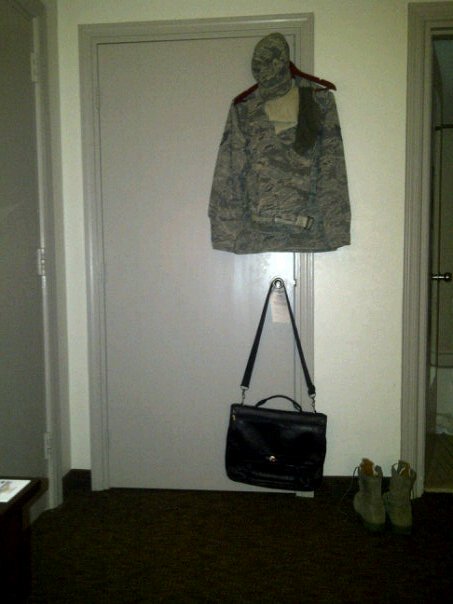
So for those of you who know me, you know what I do for a living.  And it definitely isn’t running this site, for I would be one broke ass person and would probably have to fire myself for lack of motivation.  No, my job is actually far less interesting, though some people find that hard to believe.  I’m a staff sergeant in the U.S. Air Force working in the command post.  What the hell is a command post, you may ask?  I’ve been doing the job for just over a year now, and I really can’t tell you what the hell I do.  I used to be an electrician which was really nothing more than the standard blue collar construction job that everyone else in the world would do.  No matter, the job takes me to some pretty strange places from time to time.

The Air Force has always been a part of my life in some form.  My father recently retired after 26 years of service.  Let’s just say I was a month shy from turning 26 when he retired, so there you have it.  Now, I’m no super patriotic being in any way shape or form, though I am far from a fist fighting Marxist or well-organized Anarchist.  No, to me it’s a job.  It has its benefits, and it has it downfalls.  Of course there is some honor involved, but we can just imply that part, and move on.  In fact, I will more than likely refrain from mentioning work, unless it seems absolutely necessary.  Who wants to talk about work that much, anyway? In my tenor as a military brat turned military member, I’ve made my way across the glove several times.  But, I have yet to spend more than 6 months out of the United States since coming back from a second two-year round in Turkey when I was just 8 years old.  Until now.

Biloxi, Mississippi (2011)

Yes, I will soon embark on a journey to the old world for a serious amount of time.  And I am looking forward to sharing the experience with you all.  I will be setting forth for South Korea for a solo 1 year mission in less than a month from this post, returning to the states for two briefs periods, and then setting sail (or air, I guess) with my family in tow to live in beautiful southern Spain, near El Puerto De Santa Maria.  And since it doesn’t really happen unless it is documented (some may say), I will share the adventure with everyone.  There will be obvious topics to cover like the difference between western and eastern civilization.  Especially in food, which you will soon learn is a vital subject for me when it comes to travel.   I’ll also try to find some times to recollect on a few other places I have traveled to, lived in, and/or experienced.  I hope you enjoy the ride as much as I expect to.

So let’s begin, shall we?

John Carroll Lynch [Interview]

Some actors simply have the most recognizable face.  A charming persona that never lets you down.  And it’s not that they are simply captivating to look at based upon Hollywood and societies definition of “sexy”.  It’s simply the fact that whenever you see them on the screen, you know you are not going to be upset because they are there to light up the screen in one form or another.  And for me, John Carroll Lynch is one of those actors.
Everybody is going to remember John for one role or another, considering he’s done a wide variety of roles.  Trying to decide what John is “best known for” is sort of incredulous.  If you watched a lot of TV in the 90’s, you might remember him as Drew Carey’s cross dressing brother on The Drew Carey Show.  If you are an art film geek, you’re probably going to remember Mr. Lynch as Norm in the Coen Brother’s classic film Fargo.  If you’re into television crime dramas…..you see where this is going.
John Carroll Lynch is not only a very fine actor, he is also a hell of a nice guy.  So nice in fact, he took some time out of his hectic schedule to talk with us for a moment about a number of topics and to discuss the amazing career he has had thus far, and what the future holds for one of the most lovable character actors ever to perform.  Enjoy!
You were a co-star in what is, in my opinion, one of the most underrated comedies of all time, Beautiful Girls as Franky Womack.  The film was so much fun to watch, was it a shoot as well?  With such a fantastically casted ensemble, were there any memorable experiences with the cast?  
My favorite memory of shooting the film was playing Uma Thurman’s cousin in the film and greeting her with a hug as she came into a bar. Over and over again. Not a bad day of work.
About a year later, I made a complete ass of myself at Chicago film critics awards ceremony. You see, I was cast in Beautiful Girls in Minneapolis. I was working as a theater actor there and never imagined I would see anyone I was working with or for again. Anyway, Fran McDormand was receiving an award for Fargo, couldn’t attend, and they asked me in her stead. So at the event, this very nice guy came up to me and said “John, great to see you, man.” he must have noticed the blink, blink as I looked at him. He said, “it’s Scott.” more blinking, “Scott Rosenberg, I wrote Beautiful Girls.” Ugh. Let me apologize here again. Sorry Scott.
How did you manage to pull off playing one of finest supporting husbands ever in Fargo.  What were you thinking about when you were developing this character?  Did the Coen Brothers give you much leeway in how it should be done?

Their words are so amazing what leeway do you need? While Fargo wasn’t the first film set I was on, it was the first role with a name, you know? Not Skipper, or moving man. Joel and Ethan, Fran, Roger Deakins, everyone couldn’t have been more collaborative.

Frances and I met before hand and chatted about the characters, how they might have met. “Maybe, Norm was on the force”, etc. Which made good sense to me. There were several scenes where she conducts work while he is there. It made sense that he would be interested in that. But on the first day of shooting, Joel and Ethan threw all that out. They knew that the key to Norm and Margie was that he was her safe haven and had nothing to do with her work.
Was it in any way disturbing to play a homicide detective during your stint on Body of Proof?  Was there some research involved in preparing for that role?  Anything haunting?

I rode along with a Sargent of detectives in Providence RI, where we shot season one and he was great. It was funny because he was actually embarrassed that nothing really happened while I rode along. I was cool with it. He talked about how Providence had a detective bureau but didn’t have a dedicated homicide division. I asked if that was because there weren’t enough murder attempts and he said “no, people get shot all the time, we just have really good trauma unit here.” sounded particularly great with the Rhode Island accent.

That matter of fact relationship with the violence, was really telling to me. You have to be ok with it. Murder is a pitiful act. It is filled with sadness to me. That is what I imagine as the burden. How sad it is to see over and over what we are capable of.
And the trade off is the doing something about it. He said that the interrogation room is a place where you have to be a salesmen for a prison sentence. You have to convince people that telling you what they did is good for them.  and the important thing is, to Always Be Closing.  That’s last part is me. Not him.
Have you been asked to do any more drag related roles such as your famous performance as Drew Carey’s brother?  And did you receive much praise from the cross dressing community?
No one has asked since. But it was fun. Size 22 dress by the way. The show was nominated for a GLAAD award for it as I recall. I did an interview for a cross dressing magazine and that was fun. Interesting to be interviewed by someone who is truly living that way. Steve’s desire to live life as he wanted seemed a lot braver after that.
I love getting into the shoes of the character. In that case it was the pumps.
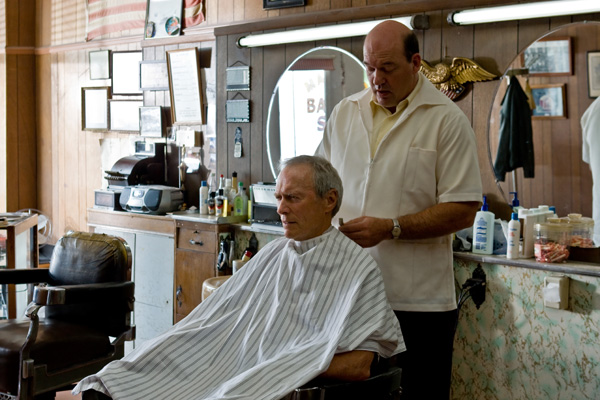
Your scenes with Clint Eastwood in his film Gran Torino were beyond classic and some of the best stuff in the film.  Was it strange swapping racial slurs with the legend?  Awkward?  And what was it like working under the direction of Clint?

I have been so fortunate to work with amazing directors. Clint Eastwood has a set where everyone works with everyone else all the time and has done so for 50 years in some cases so there is no bullshit. Simple, clear and without stress.

And he works so intuitively. As an actor and as a film maker. He wants to shoot the movie as written. He wants to capture what is happening at that moment and nothing else interests him. I put that down to his love of Jazz.  Bee Vang was very nervous and Clint said, “tell the truth and you’ll be fine.” Boil it down and that is it, isn’t it?
As far as the slurs I loved how you couldn’t have chosen two worse role models about how to be a man than these two. Very funny stuff.  My dad told me a story after seeing the movie that growing up in Pueblo, CO he heard everyone define everyone else by these racially loaded words. As a kid, he didn’t know for a long time that they were slurs. I think that is what the scenes captured. Not that they aren’t hateful but the shock of how easy it is to use them.
Needless to say, it was too fun. Great words, great set, great director, a barber smock, what more can you ask for?
We will be seeing you next year in Janee LaMarque’s new film The Pretty One.  Can you tell is about that project?  What will you be doing in the film?
The Pretty One is a beautiful story about two young women, twins played by Zoe Kazan. I play her father who is emotionally remote in the extreme. It is a charming, funny, moving script and Janee is a beautiful writer. I am looking forward to seeing how it turns out.
I am really interested in doing parts that I am not sure how to play. That was one of them. I want to be surprised. I want to surprise.
What would you say is your favorite role you have done thus far?  

The next one. Because it means I am working. I love to work.

If you could portray any famous dictator in world history, who would it be? 

Dick Cheney. Psych. I would like to play him though. Fascinating certainty.

Okay, dictators? I’ve always wondered why there isn’t a movie about Vladimir Lenin? It’s always Stalin, Stalin, Stalin! What about Lenin?
What was the last thing that made you smile?

My nephews. Ben and Michael. They live in Oak Lawn outside Chicago. I visited them.  We had a great time. Thanks, Michael and Ben. (assuming they’ll read this. trying to win an Uncle contest)

Katie O’Grady [Interview]

If you’re anything like I am, you are neurotic and underexposed to the current stream of Hollywood blockbusters and buzz worthy films.  And while this is obviously (but unintentionally) pretentious and absurd, that’s just the way some of us are wired.  Thankfully, we have our ways and means to finding joy in simple, little, and far more artistic films.  And honestly, Netflix has us covered, for the most part.  It was one dreary morning after a long night of work that I settled into a streaming pile of goodness of a film entitled Rid Of Me.  And I haven’t been the same since.
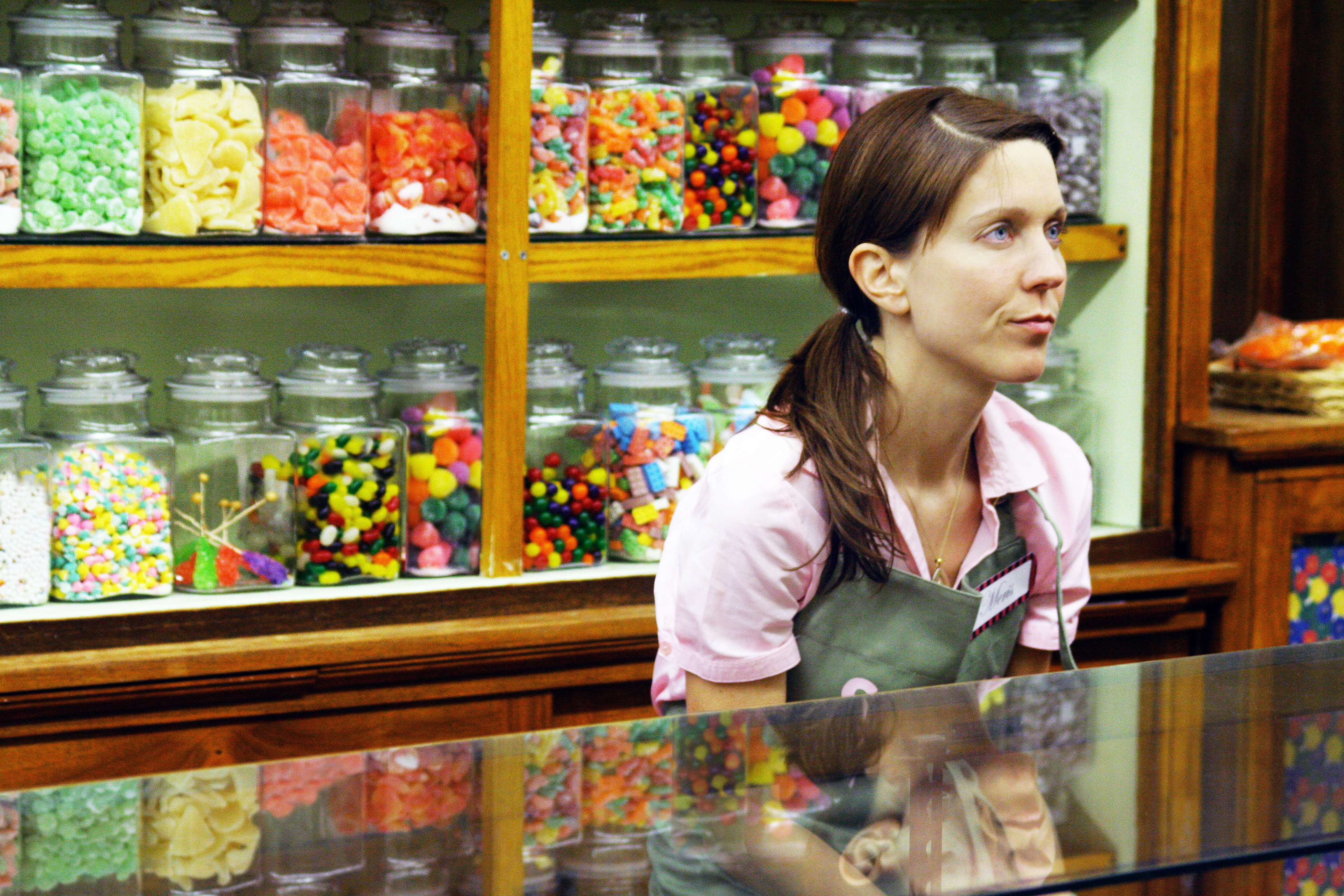
Rid Of Me is one of those sad yet bizarre films that you are surely never to forget.  The story of a woman handed a shit sandwich, and forced to eat it no matter how much she gags.  Not literally, of course, but what our heroine of the film suffers through is actually far worse.  The lovable yet utter disturbed and tormented Meris is the sort of character you just can’t help but feel bad for.  And the main reason for this can only be due to the wonderful performance from one of the today’s finest up and coming actresses and producers known only as Katie O’ Grady.
Katie O’Grady is actually nothing like the character she portrays in Rid Of Me.  She is actually an almost whimsical personality and a generally pleasing person.  She is a force to be reckoned with in the world of independent cinema.  Rid Of Me may be her highlight to date, but it is far from the last time you will be seeing this gem of an actress.  Not too mention she has a reoccurring role on the finest television show out right now, Portlandia.  We were fortunate enough to steal some of Katie’s time to talk about Rid Of Me, and what her future holds.  Check it out!
How did you become acquainted with director James Westby?  Do you work together often?
James and I worked together on The Auteur, a hysterical comedy about a porn director that returns to Portland to make his final epic film. We had so much fun filming my scenes and traveling to promote the film. I had been a fan of his films but after reading Rid Of Me I just knew I had to be part of getting it made. We have since gone on to produce several films, commercials and music videos together.
 How did Alcove Productions come to light?  What made you want to enter the world of film production?
I had been acting in film for a while when I realized  I was tired of waiting around for someone to give me a chance to show what I could do. I really felt like I didn’t have a choice, I had to produce for myself. Rid Of Me had a lead role that was opposite of who I am (in life I am blonde and outgoing, Meris is a brunette wallflower!) and a writer/director I admired. I was really determined to get that part and that included starting my own production company so I could produce it. The director went for it and Alcove Productions was off and running! Best decision I ever made.
How was your experience at the Tribeca Film Festival?  How was the reception of Rid of Me?  Did you happen to rub shoulders with anyone you’ve wanted to meet? 
Tribeca FF was better than we had imagined. For me it was not about rubbing shoulders at all, it was about getting our film seen and sold. The festival was very supportive of RID OF ME and our Producer Reps (Submarine Entertainment) along with our PR firm (42 West) really made the experience a huge learning process. The entire festival rallied to support a film that was shot for under 60k and to me THAT is what independent filmmaking is all about…getting your art out there and getting it seen! I can’t wait to return to that festival, it’s my favorite.
Rid of Me was without a doubt one of the finest films to come out in several years.  It’s been well documented that your role as Meris is almost a polar opposite of yourself.  What was your trick to transforming yourself into such a neurotic character?  Any post traumatic stress ensue? 
Thank you! I really love the film too. Yes, I am absolutely the opposite of Meris, but like her and I certainly know what it feels like to be alone or unaccepted. I despise that feeling. Meris just wants to be liked, she is desperate to get her voice heard. Approaching her was an outside in process, I first died my hair brown and changed my body language, lowered my eyes, and that shifted my inner experience with self and drew me inward immediately. I liked being quiet and observing others. I liked investigating how to disappear in a room, it was easier for me to maintain energy by giving less to others. Meris loves people…she just has no idea how to relate to them.

Regarding post traumatic stress…this is a great question! I am laughing to myself as I consider this. I recently produced a documentary about kids and teens that are bullied in the school system, there is no question that my experience playing Meris informed my passion for this new project. So far the biggest aftershock I have felt from the role is when I watch myself smear menstrual blood on another woman’s face…that gives me nightmares! Who does that?

You definitely have a prominent stance in the Portland Ore acting world.  What is your opinion of the current independent filmmakers community in Portland?  Is there a potential for growth?
The film community is thriving in Portland! I am so proud to be a part of such an up and coming city of brave artists. When someone says they are going to make a film here, they mean it. Work gets done and that speaks volumes. We also have several TV shows shooting here. Producers are figuring out that we have locations for every type of genre and a town of solid crew and actors.  It’s an amazing time to be making film. With the film incentive programs we expect to see a lot more growth of both local and studio work. I work in LA and NY but I gotta say…I love my city! Nothing beats booking work here.
You run acting classes for teens and kids.  How do you enjoy sharing your wisdom?  Is it rewarding?  If so, how?
Those kids run me…dont’ be fooled. I learn more from working with kids and teens than I could ever teach. We get serious in those classes, it’s a support for young artists that don’t fit in in the school system or with friends. So many young artists struggle, this is a class where they can gather and thrive in being THEMSELVES! When I am not on set, being in class is the next best place.
Rumor has it you will be appearing in a film with Justin Bartha and the legendary Cloris Leachman.  Can you tell us a bit about it?  
Those are the rumors I have heard as well. I am attached to Stereotypically You, a hysterical comedy about finding love.  I am really looking forward to seeing how it all comes together. We will be shooting in NY, my home away from home!
 
What else can we expect to see from you and Alcove Productions in the future? 
 

Currently I am working on I Was There, an amazing film about a fire fighter struggling after 9/11. We have been shooting in Brooklyn and NYC, it has been a powerful experience.  I just got off the set of Grimm (NBC) and am also a cast member on Portlandia (IFC-shooting it’s 3rd season), my favorite show!  I love working with Fred Armisen (SNL), he has inspired me to make my own way. Maybe someday I will look into getting a big fancy agent and seeing what more I can come up with but for now It has been an exciting ride.


Alcove Productions released RID OF ME in theaters and now OnDemand, Itunes and Showtime. We are making the soundtrack available as well as the DVD. We have a short film HOT IN THE ZIPPER (a 1940’s comedy about 3 women living in NY) on the festival circuit and a documentary/narrative film about kids and teens who are bullied, Bully’d: The Reality Of Survival, in post. James Westby, Raija Talus and I are also co-producing a 1970’s horror film, The Woodcutter. Much to come and several scripts in development. It’s going to be an exciting year!
What was the last thing that made you smile?
I am going to go all out right now, full disclosure…My new beau KILLS me with the funny. He gets me laughing so hard I can’t breathe. Laughter is where it’s at.
Stay in touch with Katie at her very own Website.

Rex Pickett [Interview]

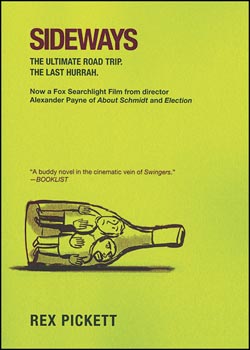
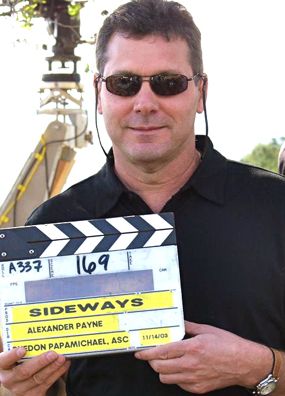
We’ve had writer’s featured on Trainwreck’d Society in the past.  Some damn good one’s too.  But our latest interviewee is definitely in a league all of his own.  He’s the man who created one of the finest novels to have ever been adapted into a screenplay that would rock the world of Hollywood as we knew it.  He also made wine cool again.
Yes, when Rex Pickett turned, for the most part, away from the world of Hollywood to focus on writing I’m certain he had no idea that his work would soon be once again engulfed around the world of modern cinema.  Around the time that movies really started to suck, there was a cultural rebirth of the independent cinema that brought the art back into cinema.  And while Robert Downey Jr and other comic book heroes continuously and desperately try to suck the art out of filmmaking, there is still some love to be had.  Rex Pickett’s book that inspired the film Sideways became the modern equivalent of some of the greatest art house films of all.
The soul intention in glamorizing Rex Pickett is not to focus on the Oscar-winning film that would become of one of his novels, but when something is just so damn impressive it can’t go unmentioned.  All of his work impeccable.  And we all know that a bad book can still make a good film.  But, a tremendous book is going to make a classic film.  Thus is the case with Pickett and his beautiful anti-hero laced and lovable story.  And he hasn’t stopped yet!  The book now as a sequel, and a third installment on the horizon.  As well as a play directly adapted from his book, not just the film.  Yes, Rex Pickett has transformed the way we look at life, wine, and what we once would like to consider decency in the modern times.
Rex was kind enough to chat it up with us for a minute here at Trainwreck’d Society!  So read on to find out what the future holds, why wine is an important social statement, and how Aliens 3 could have been SO much better.  Enjoy!
What was it like watching your words turn into a Hollywood success with the release of Sideways?
 
Nerve-wracking, then electrifying when it started winning awards and wowing audiences.  Nerve-wracking because the material’s so personal.  If it had failed it would have been a personal embarrassment — as some, I might add, predicted.  But to bare one’s soul, and then have audiences and critics loving it, that’s a high I recommend everyone try. 
How do you think Sideways changed the way people observe the world of wine?  Do you believe a new audience was introduced?
 
Sideways made wine drinking hip.  It skewered both the snobs and the cheapskates.  No longer was it okay to show up with a bottle of Two Buck Upchuck Merlot.  But the way Miles and Maya talked about wine made wine snobbery — which is the monied crowd — look like an elitist bunch, which they are.  Without question, a whole new audience was introduced to wine, and there’re a lot of statistics to back that up. 
Easter Egg
What are you actual thoughts on merlot?  Same as the ever so classic scene in the film with an enraged Paul Giamatti?
 
I’ve written about this at length, and had to answer this question at length.  Winemakers had glutted the market with Merlot for a whole host of reasons — largely because of the French Paradox.  They had vitiated a once noble grape — principally from Bordeux, but also Napa — and they deserved the spanking and the loss of revenue.  However, when I wrote the famous line I didn’t know it was going to be made into a movie, nor did I have any control whether the line would make it into the movie.  So, Merlot makers can blame both themselves and Alexander Payne. 
Last year you released Vertical, the sequel to Sideways, and word on the street is that you will soon make it a trilogy.  Can you give us any insight on what will be happening in the third installment?
 
A woman came to my Sideways the Play and said, “Did you know that you’ve written an epic love story?”  No, I did not.  Sideways is a “bromance” — pardon the horrible portmanteau word — about mid-life crisis and failure.  Vertical, my sequel, is about success.  Sideways 3: Chile is going to, perhaps, be about love. 
Not to dig into too many secrets, but…. is there a chance of a theatrical adaptation of Vertical?
 
This has been suggested to me by everyone who is gobsmached that Vertical isn’t in pre-production right now.  And I’m very seriously considering it.  I’ve already done the adaptation with my sometimes writing partner, Pamela Smith, so the heavy lifting, if you will, has already been done. 
You wrote and directed two independent films in the 80’s, then shifted your way to novels and screenplays.  Any thoughts on directing again?  Anything already in the works?  If not, what sort of film would you do?  
 
I optioned a script of mine titled Repairman.  The deal is for me to direct.  I would like to direct one film in the digital day.  Both my features were made in the analog day and they were brutal.  Barbarous.  So, yes, I hope to direct Repairman if the two women I optioned it to can find me the money. 
I heard that you working on a pilot for an HBO comedy series.  Is this still in the works?  
 
A horrible experience.  Not with HBO, who underwrote it, but with a manager at Leverage Management who is the epitome of pilot development ineptitude.  I got out of the deal before I lost my sanity.  And, it’s too bad, because it was a great idea that was slowly being destroyed by a cretin named Michael Garnett. 
I also got word that you were once working with David Fincher on writing Alien 3, but it didn’t seem to pan out.  Have you consider getting into the world of science fiction again?  
 
It’s a long story and maybe some day I’ll blog about it.  I was one of the last writers on Alien 3.  I worked very closely with Fincher on the script.  It was greenlit by Fox, then Walter Hill, a nasty little man, returned and had it shredded and demanded that Fincher make his script or else.  It was all about politics and ego, not whose script was the best.  Hollywood brings out the worse in people.
Your adaptation for the theatre version of Sideways is doing phenomenal.  For fans of the book and film, what is going to make this a different experience for the fans?
 
A great question.  I like to tell the patrons — because, well, I’m at the theater practically every night — that the play is a pure distillation of my novel, whereas the movie is Alexander Payne’s very faithful take on my novel — faithful, yet seen through the lens of his sensibility.  Sideways was written in the first person from the standpoint of Miles.  When Payne read my then unpublished novel we met.  He congratulated me on it, then said, “You know what I love about your novel so much?  Your characters are so fucking pathetic.”  And that’s how he saw them.  I didn’t.  I mean, when I wrote it I (Miles) was going through a rough patch, but I never saw him as pathetic.  Nor Jack.  A 3-time Tony Award winning director, who read the play script, but hasn’t seen the play, said it best, “It’s richer and more emotionally complex than the movie.”  And he’s a huge fan of the movie!  It’s more of a love story, too.  Payne has trouble with emotionalism in films.  I don’t.  The play IS more emotionally complex.  Also, Miles is funnier.  He’s not so down-in-the-mouth as Paul, brilliantly, played him.  I see him as a more self-deprecatingly funny guy.
What was the last thing that made you smile?
 
A 7-iron I hit 7 feet from the cup on the first hole of my first round of golf in half a year.  I used to be a good golfer.  Some days I still have it.
Stay in touch with Rex at his website, RexPickett.com.  And if you find yourself in the L.A. area, be sure to get yourself down to checkout Sideways: The Play.  And tell us what you thought!

Tony Scalzo [Interview]

The 90’s were an amazing time for music in so many ways.  Catchy, thought filled songs by “alternative” bands were all the rage, weren’t they?  Yes, there was a time before the girl and boy groups came around to kick of a shit storm that hasn’t quite subsided (fuck you very much reality TV), but is definitely getting better.  But, as time goes by, and we all get a bit older, those of us who spent the 90’s actually enjoying those video things they used to show on MTV are beginning to realize that the days that once felt like yesterday, are slowly being swallowed by time.  It’s our turn to feel the grunt of pain when millions of “those damned kids” who were too young to remember when Gin Blossoms ruled the airwaves, and even they shitty music wasn’t that bad (i.e. Hootie & The Blowfish).  But, thankfully, many of the finest acts that formed during that time are still alive and well, and touring the world.

One group that epitomizes the awesomeness of that time is definitely Fastball.  They ruled the charts for a period of time with their #1 single, “The Way”.  And while they may not be all over MTV (what musician really is anymore, right?), the crew is still very much alive and thriving in their own right.  Fastball continues to be one of the striving forces in the world of actually talented musicians.  They continue to record, tour, and be merry.  And frontman and ring leader Tony Scalzo has been kind enough to inform us on what they have been up to these days.  So without further ado, a legend in his own right, Tony Scalzo!

You began your musical career in a punk group.  How did you manage to make the transition from punk rock to a group like Fastball?  What was that transition like?

 I think it’s a stretch to say I was ever in an actual “punk” group. I have played with guys like Jack Grisham from TSOL and Mike Ness from Social Distortion. I was in a band for about ten seconds called the Flower Leppards which featured Tony Brandenberg from the Adolescents on lead vocals. Also Naked Soul with the late Mike Conley from M.I.A. I would say that while all these guys were pioneers of SoCal punk/hardcore, none of these bands was playing what you could call punk at the time. More like mid-80’s alternative rock, especially with Naked Soul; that was like the Replacements or Soul Asylum. So the transition was more one of geography than music when I move to Austin in 1993. I feel like I brought a bit of the SoCal thing with me to Texas and in Fastball it’s been that combination of elements that’s made it work.You have collaborated with some of pretty amazing artists both in the studio and on the stage.  Who has been your favorite artist to work with in any setting?  Why? 
 I have been super lucky. Right place-right time you might say. The late Billy Preston played some piano on “You’re An Ocean” back in 2000, Brian Setzer played guitar on “Love Is Expensive and Free” on that same album. We played in Amsterdam in 2001 and Steve Earle got up with us do a Stones song. Texas rock legend, Joe Ely has played with us onstage as well as super genius, Al Anderson from NRBQ. I did just recently have my friend Ian McLagan from Small Faces/Faces/Rolling Stones fame play some organ on my upcoming solo album. It’s all good, I couldn’t name a favorite because we’ve never jammed with Elvis Costello….yet!
Your hit single “The Way” is pretty straight forward lyrically.  But, is the track specific towards somebody you know?  How did the character development come to life?
 It’s a long, true story that’s been told many, many times. I had heard that an elderly couple from nearby Salado, TX had been missing for a week or so. I didn’t know the people involved but I got the story from the newspaper and speculated what may have happened to them. I’ve since met members of the family, they are nice people.
What is it like to have SXSW right in your back yard?  Do you still enjoy playing and attending the festival? 
 SXSW has been a blessing and a curse. The blessing is that it’s made Austin a major music industry player, the curse is that it’s made Austin a major music industry player! The place turns into a sort of theme park for music. But it attracts a lot of marketers and opportunists which sort of spoils it a little. I got nothing against ambitious hipsters, live and let live!
What do you think it is about Austin that makes it such a musical city?  Aside from having more bars in one area than anywhere else in the world.  Is there an influence or certain element that you believe creates the obvious diversity?
More bars in one area makes for a lot of bullshit, btw….More violence, more bad smells, more hit and run traffic accidents, etc. There is always something good to hear, any night of the week here, but it’s not necessarily happening on Sixth St. There’s Antones for Blues and Rock, The Continental for everything from Rockabilly to Alternative rock. Emo’s for alternative/Punk and Metal. Stubb’s, The White Horse, Beauty Bar, Hole In The Wall, ACL live at Moody Theater, the Paramount.  There’s Jazz, Hip-hop, classical, latin… I could go on and on.
I always have to ask this question:  Where do you keep your platinum record?  Any sentiment involved with its placement?  Why or why not?
I have a few of them, gold and platinum made by one of those trophy companies out of LA. One is hanging in my studio out back. One is in a guest room at our house. A few others are sitting in some corner of the studio. I see no reason to put up a shrine to myself!
Can we expect a new album, solo or with Fastball, in the near future?
New solo album is in mix process right now, should be available for download soon. Not sure when it will be formally released as an actual product…Fastball may record at some point in the near future yet no plans. We continue to play live on a regular basis. We actually have a busy fall coming up. See you all out there!
What was the last thing that made you smile?
My 8 mo. old son, Henry, rolling down the hotel hallway in his walker yesterday; we took him to our Fastball gig in Houston.
Keep up with Fastball at their Official Website, and be on the look out for Tony’s solo work at his own Website, currently under construction.  Cheers!

Stephen Chiodo [Interview]

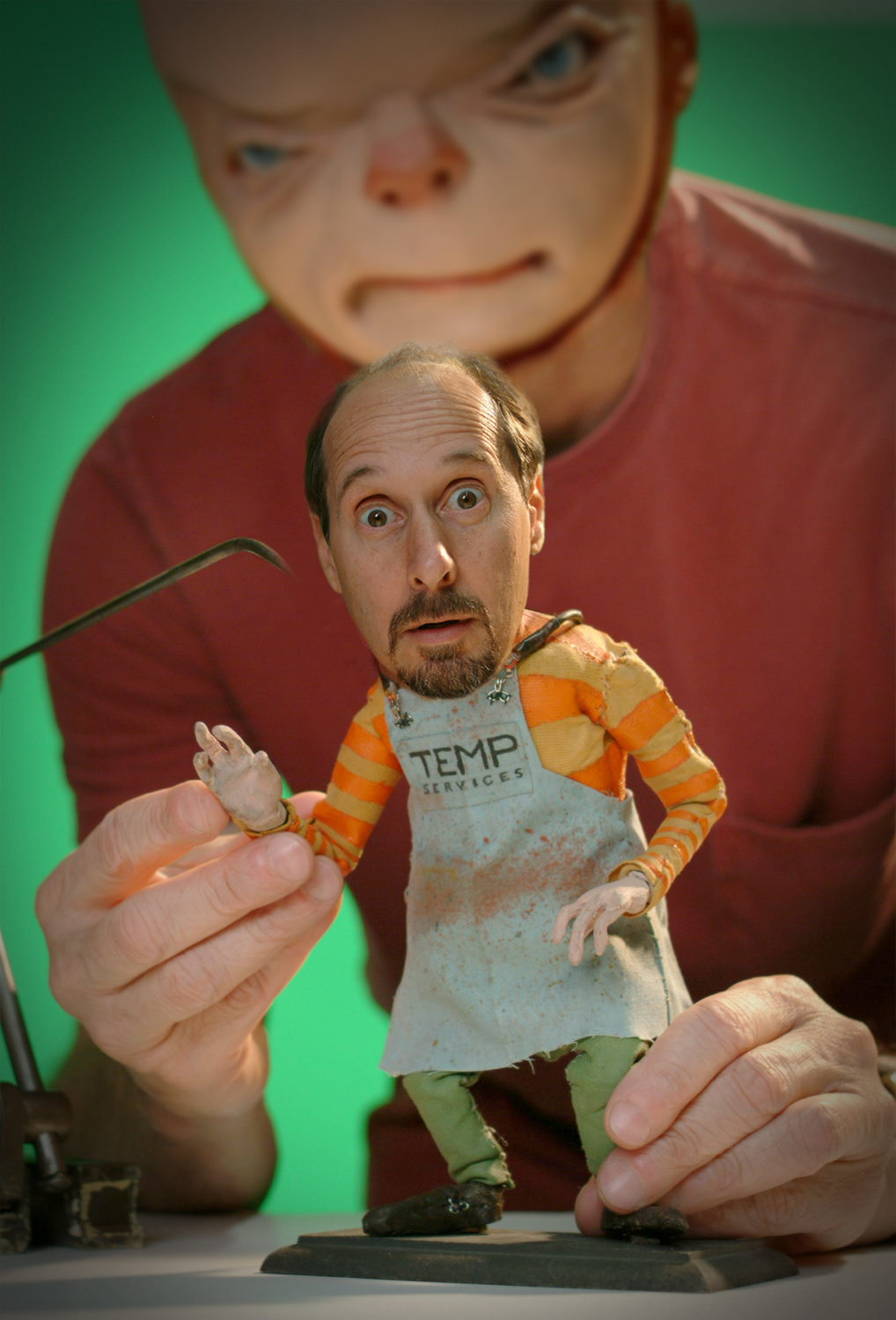
The bewilderment of what happens behind the scenes in making a film is astounding.  The immense amount of  details that go into the production side is one that is often left unappreciated.  But, in the world of animation and special effects, these are the guys who make all the difference.  And there are few people who have mastered this art of necessity as the legendary Chiodo brothers.

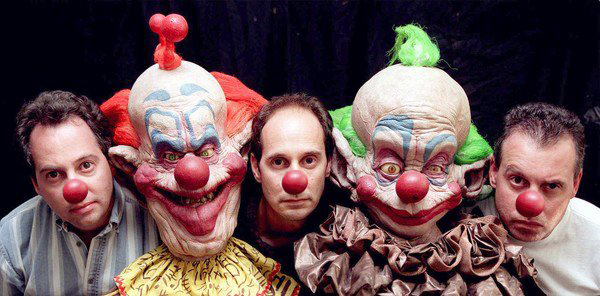
Yes, the guys who brought us the main stars of the film Critters – you  remember, Gremlins, but scarier – and the creators of the cult classic Killer Klowns From Outer Space, have been the master of puppets (all pun intended) and the creators of some of the finest animation, puppetry, and production designs are without a doubt the best in the game.  They know it all.  From stop animation in Elf starring Will Ferrell, to being the strings and fingers behind the South Park boy’s massive hit, Team America: World Police, these guys are the masters of it all.  Sure, they probably aren’t as appreciated as they should be, but it’s hard to see if they care.  They love what they do.  And it shows with the amount of effort they put into everything they do.  It’s their love for their work that proves evident.

One of these fine brothers was kind enough to share a few words with us.  We discuss clowns, puppets, and critters.  You know, the scary stuff!  So enjoy!  And remember, it takes more than one director to make a film.  Let’s honor the rest of people who make dreams happen.  Or at least a valid source of entertainment, right?

You and your brothers, Charles and Edward, are a notorious team in the world of film and animation? What would you consider the greatest upside of working alongside family?? What is a real downfall?

Charlie and I have been making films together since we were kids. Edward joined us when we moved to LA in 1980. The similarity in our background makes collaborating easier. There is an ease in our communication and the exchange of ideas that makes the creative process extremely constructive and fun. The ideas generated during a brainstorming session are varied due to our individual personalities but not too off the mark of the our original intent to be unproductive or frustrating.

On the other hand the closeness of siblings can sometimes raise the “temperature” of a heated discussion to a point where we would say things to each we would never say to someone outside the familiar relationship. Civility is thrown out the window and critiques are blunt and ruthless.
And after over 30 years in the business, what has been your favorite project you have been a part of in your career?


I have been fortunate to work on a number of memorable movie moments in my career so it’s difficult to choose just one. I’ve enjoyed many projects for different reasons.

Animating Large Marge in “Peewees Big Adventure” was a cool because it’s an unforgettable moment in a pretty funny movie.

“Critters” was the first movie Chiodo Bros was the key effects company on, responsible for designing the creatures, creating and performing a wide range of special effects for.

We created a Saturday morning kid’s show called “The Amazing Live Sea Monkeys” for CBS in the mid ‘90’s. Although it only lasted for one season it was ours creatively and we had loads of fun working with actors in prosthetics and stop motion and puppets. It was during a time when networks wanted educational elements in kid’s programming and we were proud to be declared the stupidest show on Saturday morning by TV Guide. Go Chiodo!

The stop motion work we did in “Elf” gave us the opportunity to animate a character in the same scene with the star of the movie, Will Ferrrel. That was fun.

But I’d have to say directing “Killer Klowns from Outer Space” was probably the greatest creative experience. Having the chance to make a feature based on my own idea was a blast. Seeing my concept come to life through the production process was exhausting and rewarding. And the fact that people still watch it makes me happy.

You were the principal puppeteer for Team America: World Police? Was that a different experience in the puppeteer field?? Was that the most adult oriented performance with puppets you have ever done?? 

Team America was a completely different experience for me. Marionette puppetry was not a technique we were familiar with. But as effect producers we mounted a production that built all the puppets and coordinated them on stage for shooting.

We discovered why they don’t produce many marionette movies. They are extremely difficult and time consuming to make. It was absolutely the hardest I have ever worked in my career.

We did the smart thing and hired the most talented puppeteers and let them do their best. Matt & Trey were great to work with. Rather than forcing the puppets to do things they were incapable of doing the guys found their comedy in limitations of the puppets.

The sex scene was definitely the most adult performance we ever produced. After many hours rehearsing ways to create realistic sex acts we were happily surprised to see Trey direct us toward a simple and crude performance. It was much funnier than our attempt at reality.

How did the idea for the now cult classic Killer Klowns from Outer Space, in which you wrote, directed, and produced, come to life?? What were your influences, if any?

While trying to think of the scariest thing I could think of I imagined driving down a lonely mountain road at night. When a car pulls up and passes me I see a clown behind the wheel, smiling an evil grin at me. Now that’ scary!

I’ve never felt clowns were particularly funny and a clown being where he shouldn’t be was scary to me. Charlie suggested what if he wasn’t in a car? What if he was floating in the air? Well then he must be from outer space. And that was it. We started brainstorming every clown gag and circus motif we could think and turning them into candy coated kills. We had too many for just one movie.

Rumor has it that a sequel is coming out? After 23 years, what has made you and your brothers decide to revisit the story?

Ha! We’ve been trying to get a sequel off the ground since we released the original and have met numerous obstacles over the years. I would like to report that we are closer than ever to getting the production going but things in Hollywood take a long time.

Business aside, one creative issue we had was what kind of story to tell after all these years.

It has been such long time since KKOS was released we wondered if a sequel would work for a new audience who may not be familiar it. We considered maybe a remake would be in order.

Well after much thought we decided to make a Re-Quel; a story with elements of both a remake and a sequel. We came up with a story that will introduce a new audience to the klown phenomenon and have a recurring character that will continue the original klown invasion. It’s all part of a long range story arc: a trilogy in four parts. I know the fans will not be disappointed.

You were the designer and supervisor for the legendary Critters character? What was the inspiration in designing the critter itself?? Where you given creative freedom on developing 


We had great fun on Critters. We had specific direction from Stephen Herek, the director and Domonic Muir, the screenwriter concerning the Krites. They wanted the nasty alien criminals to simply be “fur balls with teeth”.

My brother Charlie did a series of sketches and after a few adjustments I sculpted a small scale prototype and got it approved. It was a great creative collaboration.
What is the process like in developing stop animated sequences?? Is it as tedious as it seems to an outsider?

Working in stop motion is not unlike developing a scene in live action. We create storyboards to work out the action ahead of time so we shoot exactly what we need. Doing this avoids re-shooting, which wastes time and money.

It’s funny that people are under the misconception that stop motion is tedious.  I suppose the meticulous attention detail over long hours to produce only a few seconds seems mind numbing. But it’s the exact opposite. An animator is constantly thinking of hundreds of details to create a performance and the hours go by quickly. It’s a real kick to see your puppet come to life.

What was the last thing that made you smile?

Why just the other day someone on Facebook sent  me the dvd cover art for a porn parody of KKOS. The tile reads;

This isn’t KILLER KLOWNS FROM OUTER SPACE… it’s a XXX spoof!

Very bold, very trashy and very funny, to me.

It made me smile. I wondered if having my film knocked off for a porn parody signified some level of success. I mean if other directors could tolerate  “Jurassic Pork” and “Whores of the Rings” and “Tits a Wonderful Life” I could take pride to be in their company.

I’m still smiling.

Keep up with Stephen and the rest of the Chiodo brothers at their Official Website.

Tom Thurman [Interview]

Documentaries are a wonderful thing, wouldn’t you say?  They are the truth in life, spoken to us in such a fashion that one can not help but feel both informed and entertained.  Unlike a ficitonal based story, a documentary manages to offer excitement in things that actually happened, yet still leave us in awe.  And documentarian Tom Thurman has been a mastermind behind the art of documentaries in his long lasting career.

Tom may be known to folks for any number of documentaries he may have done.  But, for literary junkies and drug culture fans such as myself, I fell in love with Tom’s work when he created Buy The Ticket, Take The Ride:  Hunter S. Thompson On Film.  Essentially the film is simply a who’s who, star laced cast talking about how they knew Hunter.  But, if you look beyond the surface, you will see something far more phenomenal.  Thurman documents it best when he catches a certain celebrity mentioning that other celebrities never really fascinate a celebrity.  But, Hunter?  Hunter was the man people from every accord wanted to know.  The likes of Sean Penn, John Cusack, Nick Nolte, Johnny Depp, Bill Murray, and on and on.  They all wanted a piece of Hunter.  And Hunter wanted a piece of them.  It might have been a piece of their ear in which he would shoot off with a .45 magnum at his first liking, but it was a piece.  Hunter was  a man who lived the life he wanted to know, and didn’t give a damn about the fame.  Fame was simply the sort of being that could keep him on a steady diet of Chivas Regal and grape fruits.

And Tom Thurman brought the power of Hunter out better than any documentarian has ever managed to do.  But, given the man’s reputation and past bodies of work, it’s not hard to imagine he could do such things with the likes of Hunter S. Thompson.  He is one of the hardest working cats in the business, and you may not know it.  But, you should, and you should feel ashamed for not recognizing it.  It was a rare treat to get Tom to sit still for a few moments to answer a few questions I have been dying to as the Master of Nolte, the cinematographer of truth, if you will.  So, take a moment to see what Tom has to say, and then get your ass some education through Thurman himself.  Start with Netflix and see Hunter S. Thompson in a brand new light.  Enjoy!

What is it about documentary filmmaking that you love?  What is it that draws you to this format over feature films?

I love storytelling.  And the simplicity and intimacy of working one-on-one with people has many advantages over dragging around the bulky apparatus (logistically and financially) of a feature film.  Opportunities for distribution for docs have really improved over the past two decades, so the fear of making something that no one will ever see has diminished as well.

 From a professional stand point, how does one prepare an interview with the likes of someone like Johnny Depp, Aretha Franklin, Charlton Heston or George McGovern such as you have in your illustrious career?

You have to do your homework.  Enjoy yourself, and not take yourself too seriously.  And be patient.  Aretha made me wait for 2 days, but everyone has to wait a while on The Queen, right?

Out of everyone you interviewed during Buy The Ticket, Take The Ride, who would you say was even as close to being as eccentric as Hunter S. Thompson?

Nick Nolte.

Hunter S. Thompson.  John Ford.  Harry Crews.  And…..Nick Nolte?  How did the idea of specifically profiling Nick Nolte come to life?

Nick narrated my Thompson doc, and we got to be friends.  We wanted to do something together, but we didn’t know what it would be.  I wanted to profile him, but I wanted to approach this one differently.  The breakthrough came in a late-night conversation with the British film critic and historian David Thomson.  He suggested the idea of having Nick interview himself, and right then I knew that—if I could get Nick to agree to it—I would have something special.  That simple suggestion changed the course of the entire project.  Sometimes, you just have to be open to the ideas of others.  Of course, coming up with an idea is one thing; implementing it is another altogether.  But it worked.

You’ve drawn from very diverse subject matters in your work.  How do you usually decide what are you are going to research and sub sequentially shoot?

American film history is often my topic.  And in some ways, my projects are liked filmed essays.  But I’ve gotten to an age where I now have promised myself to have the funding and distribution in place before turning on the camera.

Is there any subject out there that you absolutely refuse to take part in documenting?  

I am not particularly interested in documenting a subject that comes with the guarantee of losing money.  I’ve done that before, and I’d prefer not to return to that arena.

If you were to create a film based on your own life, what would the title be?  Why? 

First of all, I wouldn’t make a doc about myself.  Secondly, if I did, I would call it “Do Not Watch This Film.”  Thirdly, given the subjects I’ve covered over the past twenty years (film history, literature, sports, etc.), maybe I’ve been making a film about myself all along without knowing it.

What do you feel is your greatest artistic achievement to date?

It is not one particular project, but the fact that—in addition to teaching, producing programs for Kentucky Educational Television, producing programs for ESPN, and being a father and husband—I have directed and produced 18 independent documentaries within the last 20 years.

Can you tell us what you are currently working on?


A doc. about Wendy Whelan for Kentucky Educational Televison’s Kentucky Muse series.  She has been a dancer with the New York City Ballet for over 20 years, and she is a remarkable talent.


What was the last thing that made you smile?

I was thinking about the writer Harry Crews this morning, and the film I made about him.  Every time I think about Harry, I smile.

Dustin Tri Nguyen [Interview]

We all remember Dustin Tri Nguyen from the cult classic 80’s sitcom 21 Jump Street.  Even those of us not really old enough to remember the show being on air.  But, Nguyen’s career as yet to cease in it’s own right since the show ended over 20 years ago.  Dustin has continued to appear in the acting world in the states as well as gaining prominent notarity in his home country of Vietnam.  He recently made a splash with a huge role alongside Cate Blanchett and Sam Neil in Little Fish.  Critics were awestruck from this performance, and we are sure to hear more from this amazing actor.

Dustin Tri Nguyen is an actor who feels the struggles of his work from all angles.  He’s an Asian male, for one.  The stereotypes associated with their race makes things pretty damned difficult.  Secondly, he is will probably never be able to lose the stigma of Ioki.  Not a bad stigma really, but constant recognition for a role that ended over 20 years ago can truly carry some weight.  But, through pure charisma and grace, Dustin has continued to advance his career, just as he chooses to.

We were fortunate enough to have a chat with Dustin to discuss what he has been up to lately, the stigma of 80’s stardom, and joys and struggle of acting across the globe.  Check it out!

How does the Vietnamese film industry differ from the U.S.?  Better?  Worse?

THE FILM INDUSTRY HERE IS INCOMPARABLE TO THE USA; IT’S SO SMALL AND FLEDGING – 18 FILMS MADE THIS YEAR. IT’S VERY DIFFICULT TO SAY BETTER OR WORSE. WHAT IT LACKS IN FUNDING, IT MAKES UP FOR CREATIVE FREEDOM. FILM MAKERS HERE ARE BURDENED AND TRIED BY THE SMALL BUDGETS, BUT ARE GIVEN LOTS OF CREATIVE FREEDOM BECAUSE THERE’S NO STUDIO SYSTEM; NOT YET ANYWAY. I CAN LITERALLY FINISH A SCREENPLAY, GO RAISE MONEY FOR IT AND BE SHOOTING WITHIN 6 MONTHS.

You’ve been quoted as saying you weren’t satisified with the oppurtunities of Asian males in the acting world.  In your opnion, have things gotten better?  worsened?

FIRST OF ALL, I’M ASSUMING YOU MEANT HOLLYWOOD WHEN YOU SAY THE ACTING WORLD, YES? WELL, IT DEPENDS ON HOW YOU DEFINE BETTER.  IF IT MEANS MORE JOBS; QUANTITY, THEN YES, IT HAS GOTTEN BETTER.  BUT WITH THE EXCEPTION OF JUSTIN LIN’S FILMS, THERE ARE NOT TOO MANY EFFORTS THAT GO INTO HAVING A THREE-DIMENSIONAL ASIAN CHARACTER.  THERE ARE MORE ADVANCEMENTS IN TV, I HAVE TO SAY, MORE EFFORT THERE, WITH SHOWS LIKE LOST – I HAVE NOT WATCHED AMERICAN TV SINCE LOST, BUT I’D LIKE TO THINK THAT CURRENTLY THERE ARE OTHERS. AT THE END OF THE DAY, I’M AN OPTIMIST, SO I HAVE TO SAY THAT THERE ARE SOME ADVANCEMENT, TO SAY THAT THERE ARE ABSOLUTELY NONE WOULD BE TOO EXTREME! IT IS WHAT IT IS, IT’S UNREASONABLE TO EXPECT HOLLYWOOD TO PUT ASIANS IN LEADING ROLES, OR TO PUT SOME SERIOUS EFFORTS INTO WRITING  STRONG ASIAN CHARACTERS. WOULD YOU EXPECT THREE-DIMENSIONAL WHITE CHARACTERS IN LEADING ROLES IN CHINESE FILMS, OR JAPANESE FILMS?

You have quite the extensive background in the martial arts.  What style do you participate in?  How long have you been doing it?  And why do you do it?

I FIRST STARTED STUDYING TAE KWON DO. THEN LEARN TO BOX, WHICH NATURALLY LEAD TO KICKBOXING.  BUT I DIDN’T LEARN TO KICK PROPERLY UNTIL I DISCOVER MUY THAI. BUT MY BIGGEST INFLUENCE WAS GURU DAN INOSANTO AND THE FILLIPINO ARTS THAT HE TEACHES. ALL AND ALL, I HAD STUDIED MARTIAL ARTS FROM THE TIME I WAS 15 TO 35. WHY DO I DO IT? IT WAS THE ONLY PHYSICAL THING I WAS GOOD AT. I COULDN’T PLAY FOOTBALL OR BASKETBALL OR MOST SPORTS, SO MARTIAL ARTS GAVE ME A HOME, A SENSE OF BROTHERHOOD AND FAMILY. AND MOST OF ALL, IT GAVE ME A STRONG FOUNDATION AND A BELIEF THAT I CAN OVERCOME ANY OBSTACLES, WHICH BECAME INVALUABLE THROUGHOUT MY ENTIRE LIFE.

What has been your favorite role in your decades spanning career?

IT’S A DIFFICULT ONE TO ANSWER… IT’S LIKE OF ALL YOUR KIDS WHO IS YOUR FAVORITE?!  FROM THE PERSPECTIVE OF CRAFTMANSHIP, I’D HAVE TO SAY LITTLE FISH BECAUSE OF THE CALIBER OF THE PEOPLE I WAS FORTUNATE ENOUGH TO COLLABORATE WITH. I MEAN FROM THE DIRECTOR ROWAN WOODS TO MY AUSTRALIAN CO-STARS CATE BLANCHETT, HUGO WEAVING, SAM NEIL, ETC… I MEAN YOU’RE IN THE RING WITH THE GREATS, SO YOU BETTER BRING ON YOUR BEST OF BEST.  ON A PERSONAL PERSPECTIVE, I TREASURE A LITTLE VIETNAMESE FILM I DID CALLED THE LEGEND IS ALIVE. IT WAS POSSIBLY THE MOST RIGOROUS AND MOST CHALLENGING AS WELL AS INFECTIOUS CHARACTER I’VE EVER ATTEMPTED.

How often are you stopped and recognized for your role as Ioki in 21 Jump Street?  Does it grow old?

IF I’VE GOTTEN A DOLLAR EVERY TIME I WAS RECOGNIZED FROM JUMP STREET, I COULD RETIRE NOW! YEAH, IT DOES GET OLD, ONLY BECAUSE FOR SOME REASON I CAN’T FATHOM THE LONGEVITY OF THIS SHOW. I MEAN IT WAS A LONG TIME AGO, AND PEOPLE STILL REMEMBER IT!!!

Tell us a little bit about your upcoming film Saigon, CA.  How did you become involved with Death Row Records?

JUST BY ASSOCIATION I GUESS.  THEY BECAME INTERESTED IN THE PROJECT, AND AT THAT TIME I WAS ALREADY ATTACHED TO IT.  IT’S A LITTLE FILM BASED ON A REAL EVENT OF A COMPUTER CHIPS ROBBERY IN SAN JOSE I BELIEVE.

What sort of projects can we expect to see in the future from your Early Risers Media Group in the near future.  Where did you come up with the name for the company?

IT WAS A BUNCH OF GUYS GETTING TOGETHER SO WE THOUGHT WE DIDN’T WANT A SERIOUS NAME, SO… WE’RE GUYS, SO WHAT DO GUYS GET FIRST THING IN THE MORNING?  HOWEVER, I’M NO LONGER A PART OF EARLY RISERS SO I DON’T REALLY KNOW WHAT THEY’RE GOING TO BE DOING.  WE PARTED WAYS A YEAR AGO DUE TO MANAGERIAL DIFFERENCES.  I, MYSELF, AM IN MID PREP FOR MY DIRECTORIAL DEBUT OF A SCRIPT I WROTE.  IT’S A MARTIAL-ARTS/FANTASY/SERGIO-LEONE KIND OF THING.  IT EXPLORES WHAT IT MEANS TO BE A MAN AND A REAL HERO.  SOME PEOPLE HAVE TRACKED IT AS “MONK ON FIRE”.  I’M THINKING OF MAYBE CALLING IT “ONCE UPON A TIME IN VIETNAM”, DON’T KNOW YET… BUT I’M GOING TO WORRY ABOUT SHOOTING IT FIRST!  WE’RE STARTING THIS NOVEMBER IN VIETNAM.

What was the last thing that made you smile?

THIS VERY QUESTION.

Stay in touch with what Dustin has going on at his Official Website.